
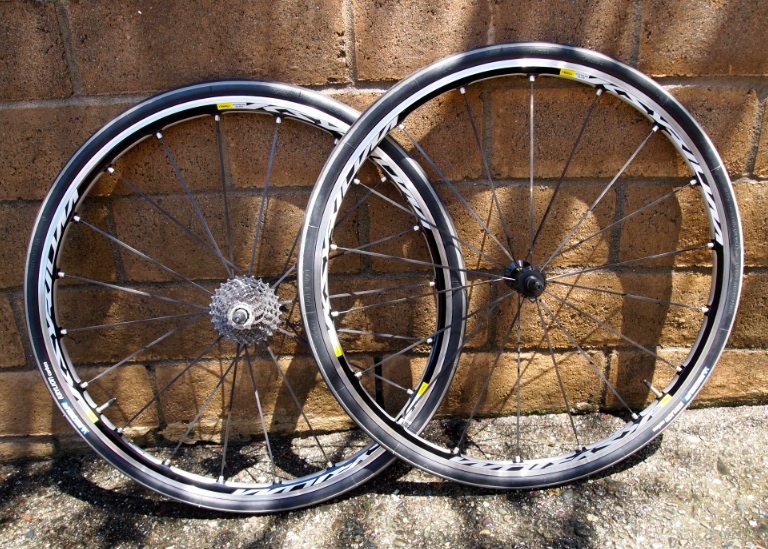
A review of the 2011 Mavic Ksyrium Elite wheelset is almost pointless. Praise of the French hoops from reviewers, mechanics, bike shop owners and riders has been consistent, effusive and universal.
Whether you race or not, weigh 145 or 220 pounds, climb mountains or train on wet, windy flat roads, the feedback is always the same. Bombproof, beautiful, lightweight and affordable.
The Ksyrium Elite seems to have found that goldmine balance of performance and price, between instant flash and long term durability.
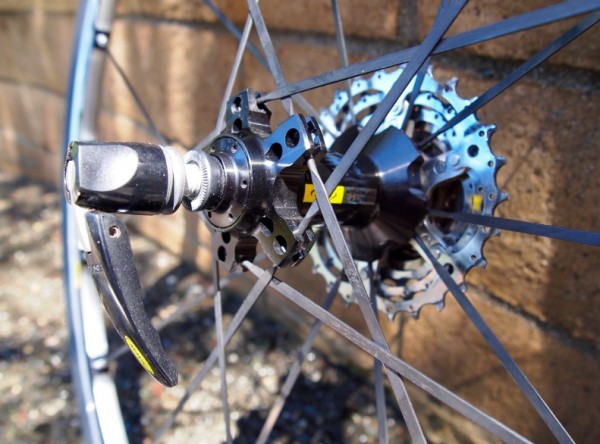
IsoPulse. Balance the tension.
We’ve ridden the Mavic Elites for the last three months and it’s fair to say we’ve had ample time to find or create flaws. We hit 213 on the scale, our weekly rides feature long Northern California climbs and fast, roller coaster descents and a weekend race that masquerades as a friendly group ride.
All those factors should have revealed some flaw, oversight or mis-judged compromise — and that’s not to say they don’t exist, simply that as yet we haven’t located any.
A few basics. The $675 Elite wheelset is aluminum, front height at 22mm and 690 grams, 18 spokes; back at 25 mm and 860 grams and 20 spokes, 1550 grams total. By way of comparison, the next step up, the Mavic SL wheel-set, may knock another 85 grams off but it will cost you an extra $325.
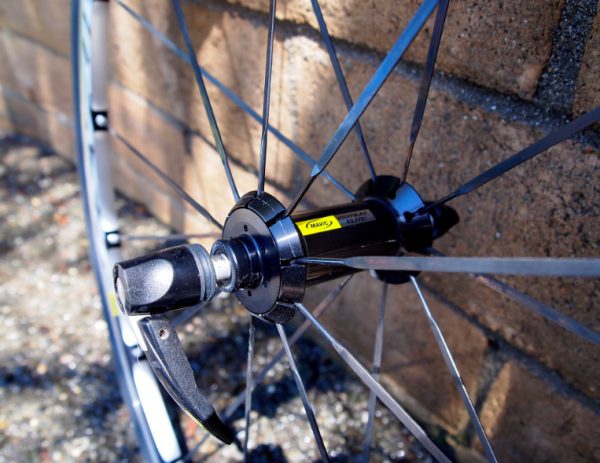
Yes, they fly.
There are several technologies that keep the Mavic Elites in that exciting climb-fast, spend-little zone. We’ll detail three but the fact is that you bonus big because nearly every proprietary innovation trickles down from the SL except the spokes.
Drilling down.
Mavic calls it Fore drilling and the irony is that it means a reduction in drilling. Basically there’s a rim box — the outer rim wall and the inner wall where the spoke attaches. Keeping that second wall free of holes dials up stress resistance and according to Mavic engineers will increase rigidity by 20%.
Mavic pioneered that now widely copied approach and they’ve had a decade for refining the process. What’s cool is the spoke insertion removes almost zero rim material. A super-heated probe pierces the rim, only the threading process takes out material. Think arthoscopic surgery, minimally invasive.
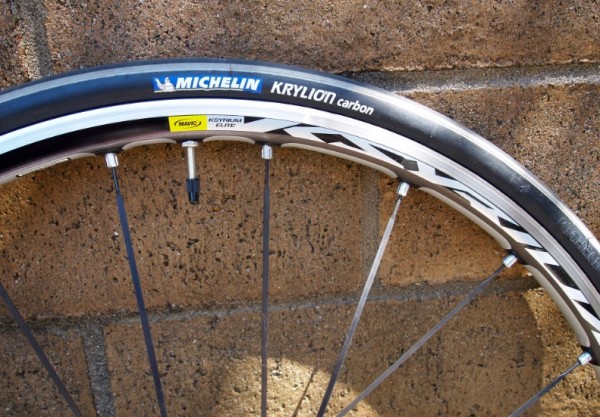
Inter-spoke milling. Weight comes off.
Preserving rim integrity and lateral rigidity are two things that boost climbing skills. Whenever we jammed out of the saddle, the power transfer felt fast enough to qualify as telepathic. And when we bombed the descents, we noticed a new confidence in holding our lines. A sweet combination.
The rotational diet.
Rolling weight at the perimeter is fat that holds you back — there are no dances on pedals. Any extra gravitational burdens put a brake on acceleration. In Mavic’s case, the solution was a diet called ISM machining, a process where they machine extraneous rim material between the spokes.
Besides the svelte new figure, you’ve also got a more responsive ride quality. The most obvious measure of a well-designed lightweight wheel-set is that instant acceleration. In our testing, there was almost a sensation of lift, like a plane taking off and it took a few rides to get used to that feeling. The Mavic Elites encourage impatience, goading you to attack earlier and not stop until the summit.
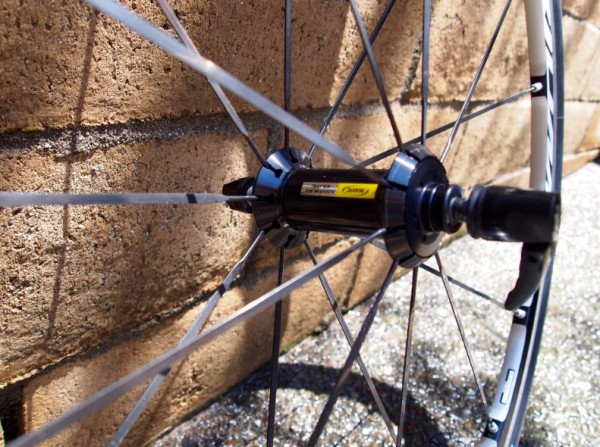
Ready to climb.
IsoPulse. The optimum angle.
The rear wheel is where the action is and where the technology shows off. The challenge is always the same: how to equalize spoke angles and tension on the drive and non-drive side. Accomplish that feat of R&D and the benefits are massive: a boost in lateral stiffness, power transmission, system integrity and rider euphoria.
Radial on the drive side and two cross on the non-drive side, the IsoPulse design pushes out the spoke angle on the drive side. As physics equations go, it’s a far more beneficial and beautiful set of opposing forces.
It’s often a challenge to isolate and identify innovations that are incremental in nature. What we did feel was how easily we seemed to spin the Elites. We suddenly had a fluidity in our pedaling motion that wasn’t there before. We’re marking that one down to IsoPulse.
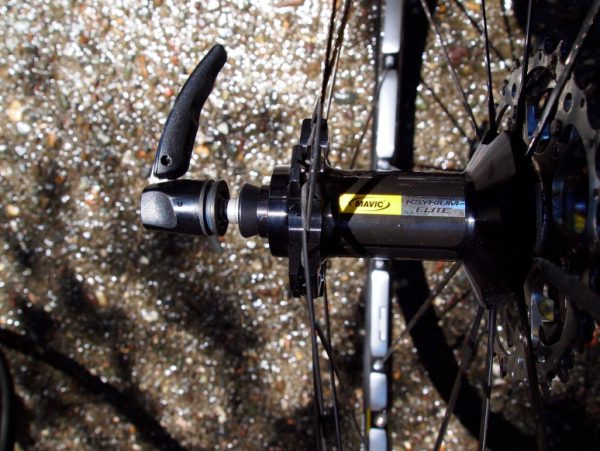
Mavic Elite. A beautiful climb.
The long road.
Any talk about Mavic begins and ends with the obligatory “durability” tag. It’s well-deserved. As a historical note, we offer two stories. We rode a pair of Mavic Open Pros for ages, including over a year with a crack in one of the rear spoke holes — without truing. Second, we still have vivid memories of being far from home and cell service when our Rolf race wheels broke a spoke. Not a fun walk.
We’re simply not buying big ticket items that don’t have a reputation for quality and a service network that isn’t just hot air. A mavic wheel-set is the promise that you never experience a DNF — Design Not Functional.
Like a Porsche Turbo Convertible or an Apple ipod, a Mavic Elite wheel-set is almost a no-brainer automatic choice. Sure, you could choose something more exotic but then you’d have some explaining to do.

Great review. I totally agree with your point regarding "not buying big ticket items that don’t have a reputation for quality and a service network that isn’t just hot air". I haven't ridden Mavic's for any length of time but the people I ride with who have them can't say enough.
I picked up a pair of Shimano RS-80 wheels that include the Dura-Ace rims with a Ultegra hub. They are a great wheelset for training or racing. No issues what so ever and I didn't pay an arm and leg for the performance.
Since when do you review equipment? Unless you're going to poke fun at some odd ball new component like Di2 or one of those bad bikes riders have to keep changing in a race, yea no one is talking about how crappie a bike must be that a rider can't finish a stage without changing it several times. Yes, it might be a component as well or just the component but still, bad equipment get on the ball Matt! I mean the riders are super concerned with safety and who wants to ride next to a rider with a crappie bike that can self destruct and cause a major crash! The world is ignoring this major news item! You could un-earth a story of epic proportions! Or will you just let it pass by?
Not sure. Tell me more details. I am doing reviews on but it wasn't clear exactly what your idea was. Matt
Well with all the speculation of a motorized bike and all the bike switching we see on those occasions, nobody has ever wondered IF the bikes are broken, or a component has gone bad or at a sponsors shame be defective. So instead of pondering on the motorized angle, there needs to be someone (you) who would ask either the Rider, DS, or mechanic, if the bikes are bad, defective, broken, kaputz, I mean the rider could not ride the bike any longer in the stage, something must be wrong with it? If enough people join in on the questioning of what is wrong or cause of the bike change, the Frame and Component manufactures won't be all to happy to be the fault of the bike change. If they do have clout this random bike changing will come to an end or at least be reduced for frivolous changes which I think we're seeing. They may try to spin it but who wants to buy a bike, component that won't last a stage? Of course there's more details but this is getting long.
Back to the wheel. I still own the TdF 2003 special edition Ksyrium's and they're still bomb proof or at least my riding proof so kinda hard to give them up for something new just yet, but if I can get a post discount I'd be willing to talk.
Well, there you go, buddy. Do you have an engineering background? Do you wanna do reviews of equipement? Do you think you'd be good at it? I'm looking for one or two people for that and yeah, most of that stuff you hang on to. Matt
Will a Masters Degree do? E-mail me for more, and I build my own bikes, gotta see it all put together.
[…] Time Trial. Told from a Mavic perspective but well-shot and interesting. As a side note, we just reviewed the Mavic Ksyrium Elite wheelset. Vaughters on Mavic wheelset. […]
[…] Barrier Lite vest, Keo Blade pedals, Mavic Infinity Bib short, Icebreaker Circuit bib short, Mavic Ksyrium Elite wheelset Share Product Reviews Commute LS zip, Icebreaker, jersey, merino wool, product […]
[…] Barrier Lite vest, Keo Blade pedals, Mavic Infinity Bib short, Icebreaker Circuit bib short, Mavic Ksyrium Elite wheelset Share Product Reviews base-layer, Icebreaker, merino wool, product review, Roto […]
[…] Barrier Lite vest, Keo Blade pedals, Mavic Infinity Bib short, Icebreaker Circuit bib short, Mavic Ksyrium Elite wheelset Share Product Reviews George Hincapie, product review, Signature eVent rain […]
[…] Mavic Ksyrium Elite wheelset Share Product Reviews Mavic, Plasma SLR, product review, road helmet The Vuelta goes Giro. […]
[…] Mavic Ksyrium Elite wheelset Share Product Reviews Emergence bib short, George Hincapie, Hincapie Sportswear, product review Rogers on Wiggins & Cavendish at Tour. A lime green jersey? WADA expert muzzled in Contador case. Flamingo dance okay. […]
[…] Mavic Ksyrium Elite wheelset Whisper head shot. […]
[…] Mavic Ksyrium Elite wheelset Share Product Reviews Classic bib short, product review, Rapha Catalunya chaos. Time gaps transferred to Vuelta a Espana. Boonen takes bunch sprint in E3. […]
[…] Mavic Ksyrium Elite wheelset […]
[…] Mavic Ksyrium Elite wheelset […]
[…] Mavic Ksyrium Elite wheelset […]
[…] Mavic Ksyrium Elite wheelset […]