
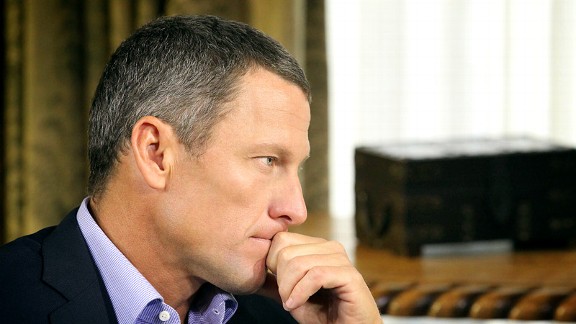
And now, the choked-up part of the Dopra Lance-athon. If part one was the Admission, part two was the Emotion. Or shall we say, the lack thereof.
It was time to bring suffering to the front in order to gain the sympathy of a huge television audience. There wasn’t much emotion in the apologies to the people he’d crushed, but when it came to his own kids, Lance was more heartfelt.
His lines about how his son Luke was defending him at school were poignant and provided what felt like one of the few non-scripted moments of the entire interview. He didn’t shed a tear but he worked the sniffles pretty well. Two women in our home audience thought he faked half of them, but we’ll be generous with the other half.
There is however the disturbing habit that Lance has of describing himself in the third person. That semantic style symbolizes the distance he puts between himself and the terrible things he has done to people. It’s the fault of “that guy,” not Lance himself. There’s also a carefulness and calculation to his answers that removes the emotion and a sense of genuine remorse or understanding of the damage he has caused.
In the end, we have to wonder what exactly he gained with his decision to end the charade with talk show host Oprah Winfrey. By selecting that TV admission route, the goal would seem to have been to gain sympathy from a wide audience beyond cycling. The formula for these shows is to stew in your own acidic juices, you squirm, you cry, you detail your sorrows and pain, you call yourself names, how the lies tore you apart inside, how it destroyed your marriage and turned your kids against you. Self-flagellation in return for sympathy. See? I’m human, I make mistakes, I have regrets just like you!
The only problem with that approach is that Armstrong doesn’t do weakness well. It’s not in his hyper competitive nature to show any weakness — and he stopped so long ago that the very idea is alien. Weakness is for losers like Bassons and Filippo Simeoni. Strength and force of will gets you on the podium; that’s Lance’s world. Being down on the killing floor, crying and asking for help isn’t his thing.
That’s why we think Armstrong’s Oprah showing will get him very little in the way of redemption. It was simply too little and far too late. The control freak had already lost control of the script forever. Yes, as Tyler Hamilton and his first wife told him, the truth will set you free. But Armstrong wasn’t on Oprah for the truth because that had already been brilliantly exposed by Travis Tygart and USADA.
No, he wanted a measure of forgiveness but didn’t have what it required emotionally for him to get it. His lack of feeling, the scripted quality of his answers, the flatness of his apologies, his inability to speak all of the truth (the hospital room, the USADA money offer) — all those things prevent him from connecting with his audience.
That failure is about a controlling personality that’s at a loss what to do when he’s no longer in control. He simply can’t let go, can’t stop trying to manipulate, only now that time has past. It’s like he’s the last one in the room to get the news. When every news channel portrays you as not only a cheat, but a vindictive and ruthless bully, there’s not much you can do to counteract that with Oprah unless you’re prepared to break down and bare your tortured soul.
It reminds us of the line from the film The Crying Game. “Why did you sting me, Mr. Scorpion? For now we both will drown!” Scorpion replies, “I can’t help it. It’s in my nature!” It is not in Lance Armstrong’s nature to show weakness or emotion. That is why we’d rate his Oprah performance as poor. Perhaps under oath, we’ll see some more emotion.

Spot on…….except for the last. I doubt we’ll see any emotion in court either.
You’re probably right. Lance keeps calling it a process so maybe there’s some remorse and emotion at the end of the road.Matt
At some point, we’re really going to have to accept Lance Edward Gunderson (Armstrong) for who and what he really is.
That he is Psychopathic.
He follows the structural basis of a Psychopath perfectly. Failed marriages, failed social life, and the pure denial he really did anything wrong. His “back against the wall” quote comes from pure rage. Rage of a father that never was. Rage of being picked on as a child, rage against anyone that got too close. And rage of failure at any level. I do feel sorry for Lance. I really do. I think buried deep in all of that anger is the real Lance. A person only one person knows intimately. His mother. Not Kristin, not Sheryl, not Kate, Not Ivanka, and not Anna. If he’s in therapy, then the Psychiatrist that is working with him should be fired. Lance’s problems stem from his childhood. The key to Lance’s real truth telling, will come from someone that can get inside. Mom. She holds his ability for any reconciliation and truth. The only time he looked genuinely emotional was when he discussed Luke and his mom. He knows deep down what damage has been done. He is still defiant, still fighting, and still selling. When will the madness stop Lance. The time is now. You have the power within you to change for real. Hell, you built a cancer organization to combat the evils of cancer. That foundation no one can take away. Time to follow your own credo Juan, and begin to “LiveStrong”. Peace Amigo…